Passports Over Scholarships: The Quiet Exodus Threatening American Collegiate Fencing

Every spring, American high school fencing programs produce a cohort of junior athletes capable of competing at the highest levels of the sport. A decade ago, the path forward for nearly all of them ran through the same gate: an NCAA athletic scholarship, four years of collegiate competition, and a gradual transition toward senior international fencing. That path is no longer the only one — and for an increasing number of the most talented young American fencers, it is no longer the preferred one.
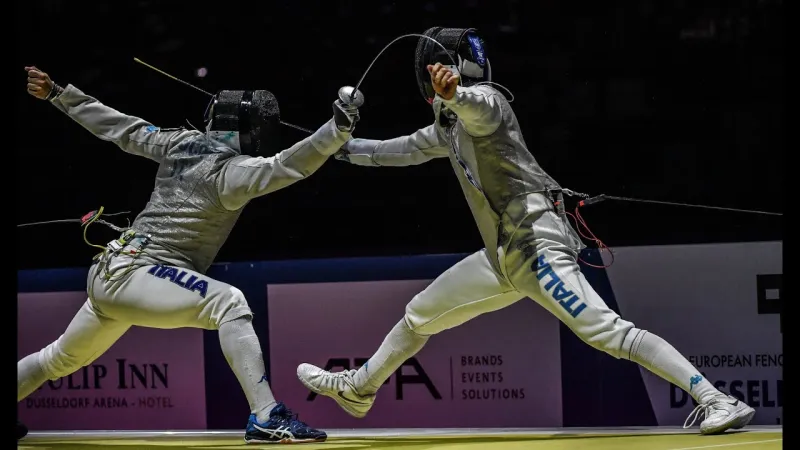
The 2018 European Fencing Championship, watched by a larger American audience than any prior edition, served as both a showcase and a recruitment advertisement. For juniors already weighing their options, watching the depth and intensity of European club competition on a live stream from their living rooms in New Jersey or California was, for some, the final argument. The scholarship could wait. The club spot in Budapest or Paris could not.
The Pull Factors Are Real
To understand this trend without dismissing it as youthful impulsiveness, one must acknowledge the genuine competitive advantages that European club placement offers a developing fencer. The training environments at established clubs in Italy, France, Germany, and Hungary are, in aggregate, superior to what most NCAA programs can provide. Daily access to multiple high-level training partners, coaching staffs with deep technical lineages, and competition calendars that include regular international events create a developmental acceleration that the American collegiate system — constrained by academic calendars, NCAA eligibility rules, and athletic department budget priorities — struggles to replicate.
The 2018 European Championship roster included several athletes who had trained in European club environments since their mid-teens, some of whom were the products of exactly the kind of early placement that American juniors are now pursuing. Their performances in Novi Sad were, for any attentive observer, a data point in favor of the European developmental model.
Beyond training quality, there is the matter of competitive immersion. A junior fencer embedded in a European club competes frequently against senior international athletes in training and in domestic competition. The calibration effect — learning to perform under pressure, against elite opposition, without the protective structure of a college athletic program — is difficult to replicate in any other environment.
The Push Factors Are Equally Real
If European clubs are pulling American juniors outward, structural features of the American collegiate fencing system are simultaneously pushing them. NCAA fencing scholarships, while valuable, are rarely full athletic grants-in-aid. Unlike football or basketball, fencing is an equivalency sport, meaning scholarship money is divided among roster members rather than awarded in full to individual athletes. A nationally ranked junior fencer may receive a partial scholarship that, when weighed against the opportunity cost of European club placement, looks considerably less attractive than it once did.
Additionally, NCAA eligibility rules impose meaningful restrictions on the competitive activities of college athletes. A fencer enrolled at an American university cannot accept club contracts, compete in certain open international events without jeopardizing eligibility, or train with professional programs during the academic year. For an athlete whose primary goal is national team qualification and international success, these restrictions represent a genuine developmental constraint.
The visibility of the 2018 European Championship has made these trade-offs more legible to junior athletes and their families than they have ever been. When a seventeen-year-old can watch, in real time, the training culture and competitive intensity that European clubs produce, the abstract appeal of a campus experience becomes harder to weigh against the concrete appeal of elite development.
What This Means for Collegiate Programs
The implications for NCAA fencing programs are significant and, if left unaddressed, compounding. The loss of any single top-tier junior recruit to a European club is manageable. The systematic loss of the highest-potential athletes in each graduating class is not.
Collegiate fencing programs derive their national team pipeline value from the concentration of elite talent they develop. If that talent increasingly bypasses the collegiate system in favor of European placement, the programs that remain will recruit from a narrower talent pool, produce fewer national team-caliber athletes, and gradually lose the institutional credibility that attracts future recruits. It is a feedback loop with an unpleasant terminus.
Several NCAA programs have already begun to feel this pressure. Coaches at programs with historically strong fencing traditions have reported increased difficulty securing commitments from top junior prospects, with European opportunities cited as a competing factor in recruiting conversations. This is no longer an anecdotal concern — it is a structural one.
The Case for Institutional Evolution
The response to this trend cannot be denial, and it should not be resignation. American universities have resources, institutional flexibility, and genuine competitive advantages that European clubs cannot fully replicate. The task is to deploy those advantages more strategically in the competition for elite junior fencers.
Several reforms merit serious consideration. First, athletic departments with serious fencing ambitions should explore restructuring scholarship allocation to offer full or near-full grants to their highest-priority recruits, even if this requires reducing overall roster size. A smaller, more elite squad built around fully funded athletes is a more competitive recruiting proposition than a larger squad of partially funded ones.
Second, NCAA programs should pursue formal partnerships with European clubs that allow enrolled athletes to train or compete abroad during academic breaks without triggering eligibility complications. Such arrangements would allow collegiate programs to offer a hybrid development pathway — American academic experience combined with periodic European competitive exposure — that no current program provides.
Third, and most fundamentally, American collegiate fencing programs must engage honestly with what the 2018 European Championship demonstrated about the developmental gap between the two systems. Recruiting pitches that ignore this gap will be less persuasive to informed junior athletes than pitches that acknowledge it and articulate a credible plan to address it.
A Moment of Reckoning
The trend of American juniors choosing European clubs over NCAA scholarships is not yet a crisis. It is, however, a clearly legible signal — one that the 2018 European Fencing Championship has amplified for anyone paying attention. The collegiate programs that respond to this signal with structural adaptation will retain the talent pipelines that sustain their competitive identities. Those that do not will discover, gradually and then suddenly, that the best young American fencers have found a different road to the elite.
The passport, for a growing number of them, is already in hand.