Reading the Room: How American Fencers Can Crack the Tactical Code of Europe's 2018 Elite
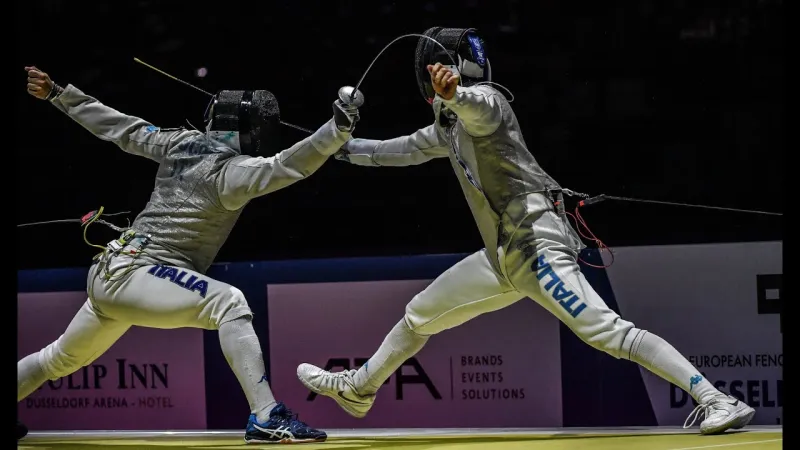
Photo: fencing competition tactical strategy European championship athletes on piste, via i.ytimg.com
For American fencers preparing for international competition, the 2018 European Fencing Championship represented something beyond a series of medals and podium photographs. It was, in effect, a comprehensive strategic dossier — one compiled in real time by the continent's most accomplished competitors. The question is not whether that intelligence exists. The question is whether American athletes and their coaches are equipped to read it.
Breaking down what happened in Novi Sad requires more than replaying highlight footage. It demands a structured, analytical approach to understanding why European fencers make the choices they do, and how those choices create exploitable patterns — or, conversely, near-impenetrable tactical walls — for opponents who arrive unprepared.
The Italian Foundation: Patience as a Weapon
No national program at the 2018 championship demonstrated a more consistent philosophical identity than Italy. Across all three weapons, Italian fencers displayed a commitment to controlled distance management that bordered on methodical. Rather than forcing early action, Italian competitors routinely invited their opponents to initiate, then capitalized on the resulting commitment with precise counter-attacks and precisely timed parry-riposte combinations.
For American fencers accustomed to a more assertive attacking tempo — a tendency reinforced by domestic competition formats that reward early aggression — encountering an Italian opponent can feel disorienting. The piste seems to shrink. Time seems to slow. The solution is not to abandon aggression entirely, but to vary the rhythm of engagement deliberately. Introducing false attacks, broken tempo advances, and unpredictable feints can disrupt the Italian system's reliance on reading opponent commitment before responding.
Coaches working with US athletes should incorporate controlled sparring sessions specifically designed to simulate this patient, reactive style. Assign training partners to adopt a purely counter-attacking mandate and force the American fencer to solve the puzzle of drawing a genuine response without overcommitting.
French Finesse: The Geometry of the Blade
French fencers at the 2018 championship, particularly in foil and épée, exhibited a distinctive emphasis on blade engagement geometry. Where other national schools might rely on physical speed or explosive footwork to create scoring opportunities, French competitors demonstrated a preference for manipulating the blade relationship — using pris de fer actions, envelopments, and subtle pressure changes to redirect an opponent's weapon before the final line of attack was committed.
This approach is technically demanding to replicate under pressure, but American fencers do not necessarily need to adopt it wholesale. What they need is the ability to recognize it and respond to it. The critical vulnerability in a blade-geometry-focused system is distance disruption. A French fencer who has established a comfortable blade engagement can be unsettled by a sudden retreat followed by a quick, unexpected advance — breaking the spatial relationship they depend on to execute their preferred actions.
US coaches should make a point of drilling blade engagement recognition drills. The goal is not to out-finesse a French opponent at their own game, but to identify the moment the engagement is being established and interrupt it before it becomes a structural advantage.
The Hungarian Sabre School: Aggression With Architecture
Hungary's sabre tradition is among the most storied in the history of the sport, and the 2018 championship confirmed that the modern iteration of that tradition remains formidable. Hungarian sabre fencers combine an expectation of high-tempo, explosive exchanges with a structural sophistication that prevents their aggression from becoming predictable.
The signature characteristic is the prepared attack — an advance that carries genuine threat at multiple points along its trajectory. Unlike a simple fleche or a straightforward running attack, the Hungarian prepared attack forces the defender to commit to a parry choice before the attacker's final intention is revealed. American sabre fencers who rely on reactive defense will find themselves perpetually a half-step behind.
The counter-strategy here involves denying the Hungarian fencer the opportunity to establish their preferred attacking distance. Aggressive use of the warning line, willingness to trade ground for time, and a commitment to stop-cutting into the preparation phase of the attack are all viable approaches. American coaches should study footage from the 2018 sabre events specifically to identify the preparatory footwork patterns that precede Hungarian attacks — foreknowledge of those patterns is the first line of defense.
Russian Épée: The Long Game
Russian épée competitors at the 2018 championship demonstrated a tactical patience that parallels, in some respects, the Italian approach — but with a distinctly different objective. Where Italian fencers tend to engineer clean parry-riposte opportunities, Russian épéeists showed a preference for accumulated pressure: repeated point-in-line threats, disciplined use of the fleche to the wrist or forearm, and a willingness to accept double touches when the point differential favored them.
For American fencers, competing against this style requires an unusually high level of score-awareness. A Russian épée opponent who is trailing by one touch may fight an entirely different bout than one who is leading. Tactical adjustments mid-bout — reading when a Russian fencer has shifted from a point-accumulation strategy to a closing strategy — are essential. US fencers who treat every touch as an isolated event, rather than a component of a larger arithmetic calculation, will be consistently outmaneuvered.
Building an Intelligence-Based Preparation Program
The practical application of this analysis begins before an American fencer ever steps onto an international piste. The 2018 European Championship produced a substantial archive of footage, bout statistics, and observable tactical patterns. US coaches who invest time in cataloguing those patterns by nationality, by weapon, and by individual competitor will arrive at international tournaments with a genuine preparation advantage.
Several specific steps are worth prioritizing:
Footage-Based Scouting: Identify the top-ranked European competitors in your athlete's weapon category and log their five most common scoring actions. Patterns will emerge.
Style-Specific Sparring: Assign training partners to simulate specific national styles. This is not about stereotyping opponents — it is about expanding the American fencer's tactical vocabulary so that no approach feels genuinely foreign.
Distance Calibration Drills: Many European tactical systems depend on establishing a preferred operating distance. Drills that force American fencers to disrupt, reclaim, and redefine working distance will build the adaptability needed to counter multiple styles within a single tournament day.
Rhythm Variation Training: European fencers, broadly speaking, are more comfortable with broken tempo and deliberate rhythm manipulation than the average domestic American competition environment demands. Building comfort with unconventional timing is among the highest-return investments an American competitor can make.
The 2018 European Championship was a masterclass in tactical diversity. For American fencers willing to treat it as a curriculum rather than a spectator event, it offers a competitive edge that no amount of domestic training alone can replicate. The blueprint is there. The work is in learning to read it.