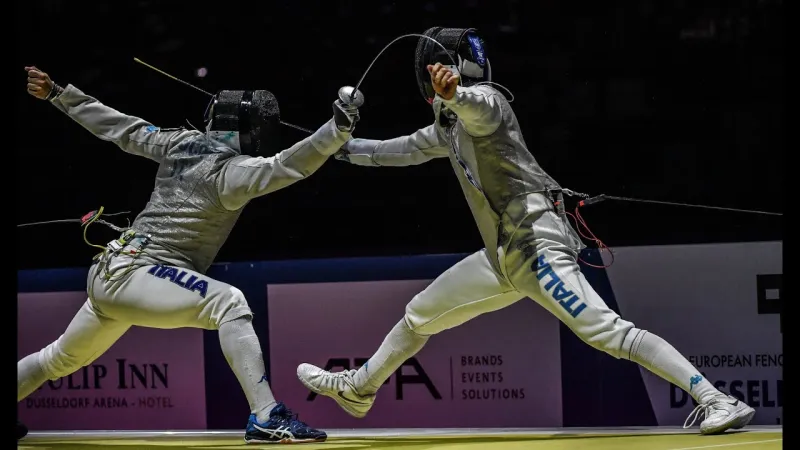
Numbers Don't Lie: What the 2018 European Championship Data Tells Us About Fencing's Next Era

Statistics in fencing have historically been an afterthought — a footnote appended to narrative coverage of individual bouts and championship ceremonies. The 2018 European Fencing Championship, held in Novi Sad, Serbia, offers a compelling argument for elevating the analytical lens. Across fourteen individual and team events, the competition produced a dataset dense with surprises: unexpected medalists, age distributions that challenge long-held assumptions about peak performance, and the continued rise of nations that were, until recently, considered secondary fencing powers.
For American fencers and coaches tracking the competitive landscape, these numbers are not merely interesting — they are instructive.
The Upset Index: Conventional Wisdom Under Pressure
Perhaps the most striking statistical feature of the 2018 Championship was the frequency with which seeded favorites failed to advance past the quarterfinal stage. Across all weapon disciplines, the rate of top-eight seed elimination before the medal rounds was notably elevated compared to prior championship cycles.
This pattern is significant for several reasons. It suggests that the competitive depth across European fencing nations has increased to a degree that seeding models — which tend to weight recent World Cup results and international ranking points — may no longer reliably predict medal-round composition. The implication for American fencers preparing to compete internationally is direct: the field is becoming less predictable, and tactical preparation based on opponent-specific scouting must account for a wider range of potential adversaries.
The upset rate was particularly pronounced in men's épée, where three of the top four seeds were eliminated before the semifinals. Analysts tracking the event noted that the successful upset artists shared a common tactical profile: aggressive distance management, high-frequency feint sequences, and an unusual willingness to accept double touches in exchange for disrupting an opponent's rhythm. This is a tactical signature worth studying.
Age Curves: The Peak Is Moving
Conventional wisdom in competitive fencing has long held that athletes reach their performance apex somewhere between the ages of twenty-four and twenty-eight, with a gradual decline thereafter. The 2018 European Championship data complicates this picture considerably.
In women's sabre, the average age of all eight quarterfinalists was twenty-six — consistent with historical norms. But in men's foil and women's épée, the average age of medal-round participants skewed noticeably older, with multiple athletes in their early-to-mid thirties performing at championship level. Meanwhile, several junior-to-senior transition athletes — competitors in the nineteen-to-twenty-one age bracket making their first appearances at senior European level — reached the round of sixteen in disciplines where such early breakthroughs have historically been rare.
What this bimodal age distribution suggests is that the sport is developing in two simultaneous directions. Technical and tactical refinement is enabling experienced athletes to extend competitive longevity further than previous generations managed. At the same time, the quality of junior development programs across Europe is producing athletes who are competition-ready at younger ages than the historical baseline would predict.
For American fencing programs, this has concrete planning implications. Development timelines that assume a gradual ramp to senior competitiveness may need to be compressed at the junior end, while retirement planning assumptions for senior athletes may need to be extended at the other. Both adjustments require investment — in early specialization coaching for juniors, and in performance maintenance infrastructure for senior athletes.
The Geography of Medals: New Nations, New Threats
The medal table from the 2018 European Championship confirmed what attentive observers had been tracking for several years: the geographic concentration of European fencing excellence is dispersing. Historically, the Italian, French, Hungarian, and Russian programs have accounted for the majority of European Championship hardware. In 2018, that dominance persisted — but the margins narrowed, and the nations crowding the edges of the medal table deserve careful attention.
Programs from Georgia, Azerbaijan, and Ukraine contributed medal-round performances across multiple weapon disciplines that would have been statistically anomalous a decade ago. These nations share several developmental characteristics: centralized national training programs modeled on Soviet-era institutional structures, coaching staffs with deep technical lineages, and relatively young senior rosters suggesting continued upward trajectory.
For American national team planners, the rise of these programs is relevant not only as a European competitive matter but as a global one. Athletes from these nations are likely to appear with increasing frequency at World Championships and Olympic qualifying events, reshaping the competitive landscape that American fencers must navigate.
Touch Efficiency and Tactical Patterns
Beyond medal distributions and demographic data, the 2018 Championship produced granular performance metrics that reward close analysis. Touch efficiency — the ratio of scoring actions to total actions initiated — varied significantly across weapon disciplines and competitive rounds.
In sabre, the championship's later rounds showed a marked increase in first-action scoring rates compared to preliminary pool bouts. This reflects the well-documented tendency of elite sabre fencers to front-load aggression in high-stakes moments, prioritizing the psychological advantage of early scoring over tactical patience. American sabre coaches should note that training environments which simulate this pressure dynamic — through format adjustments and high-stakes practice bouts — may produce better championship-stage readiness than volume-based sparring alone.
In foil, the data revealed an interesting divergence between individual and team event performance patterns. Athletes who underperformed their seedings in individual events frequently rebounded in team competition, suggesting that the collective tactical environment of team fencing activates different performance variables than individual bouts. This finding has direct implications for how American programs structure their team selection and preparation processes.
Translating Data Into Direction
The 2018 European Fencing Championship was, by any measure, a competitive success. But for the American fencing community, its most enduring value may lie not in its narrative drama but in its analytical residue. The numbers generated across fourteen events constitute a roadmap — imperfect, incomplete, but genuinely directional — toward understanding where elite fencing is heading and what it will demand of the athletes who aspire to compete at its highest levels.
The field is widening. The peak is shifting. And the upsets are becoming the story. American fencers who internalize these trends will arrive at future international competitions not merely prepared — but oriented.