Build Your Edge: A Systematic Approach to Scouting European Competitors Using 2018 Championship Data
In professional team sports across the United States, scouting reports are considered non-negotiable preparation tools. Football coaches review hours of opponent film. Baseball analysts catalog pitch tendencies down to the count. Yet in American fencing circles, systematic opponent analysis remains remarkably underdeveloped — a gap that the 2018 European Fencing Championship has made impossible to ignore.
The championship, held this past summer, generated an unusually rich archive of broadcast footage, bout-by-booth score records, and publicly accessible competition data. For American fencers with ambitions of competing against European elites, that archive is not merely a historical record. It is a scouting database waiting to be used.
This article outlines a structured framework for building a personal scouting report on European competitors, drawing directly from materials produced at the 2018 championship.
Start With the Scoreboard, Not the Highlight Reel
The instinct for most fencers reviewing championship footage is to gravitate toward the dramatic moments — the decisive touches, the championship bouts, the medal ceremonies. That instinct, while understandable, is analytically counterproductive.
The most revealing data in any fencer's performance profile lives in the early rounds, where opponents are less cautious, patterns are less disguised, and decision-making under moderate pressure is most visible. Begin your scouting process by locating pool bout recordings from the 2018 championship rather than direct elimination footage. Pool bouts, often overlooked by casual viewers, expose habitual tendencies that elite fencers discipline themselves to suppress when the stakes intensify.
As you review this footage, resist the urge to evaluate individual touches. Instead, track sequences. Ask yourself: How does this athlete initiate action in the opening thirty seconds of a bout? What footwork pattern precedes their most frequently successful attack? Do they favor a particular line when retreating under pressure?
Document these observations in writing. The act of articulating a pattern forces analytical precision that passive viewing does not.
Building a Footwork Signature Profile
Footwork is the dimension of fencing that reveals competitive temperament more reliably than any other technical element. At the 2018 European Championship, the footwork distinctions between fencers from different national programs were pronounced enough to constitute identifiable stylistic signatures.
When constructing a footwork profile for a specific competitor, focus on three measurable variables: their default engagement distance, their retreat-to-counterattack ratio, and their recovery position after a failed offensive action.
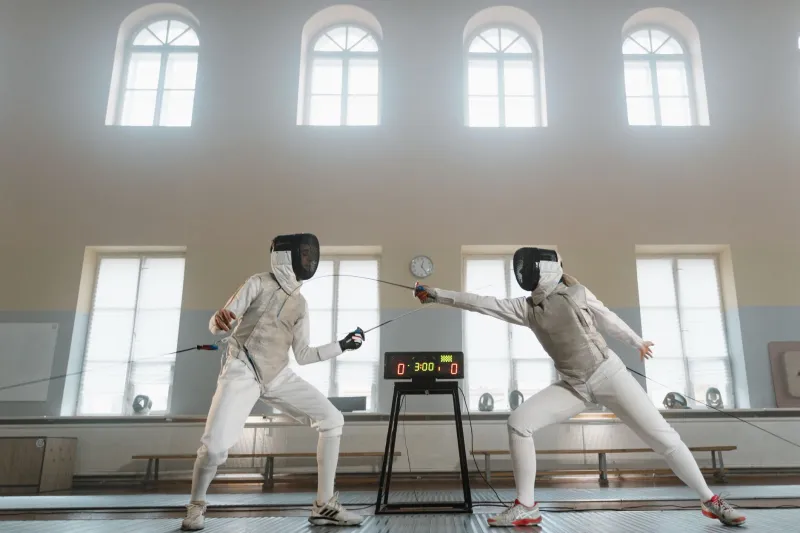
Default engagement distance refers to the strip distance at which a fencer consistently chooses to initiate or invite action. Some European competitors at the 2018 championship demonstrated a marked preference for operating at extended distance, using their reach advantage to neutralize American opponents who trained primarily at closer quarters. Others showed a consistent pattern of crowding the engagement zone, disrupting timing through physical pressure rather than technical superiority.
The retreat-to-counterattack ratio is precisely what it sounds like: how frequently does a fencer, when driven backward, convert their retreat into an offensive action versus continuing to absorb distance? Fencers with a high conversion ratio are predictable in a specific, exploitable way. They are conditioned to attack off the retreat, which means a patient American competitor can manufacture retreats deliberately to invite predictable counters.
Recovery position analysis requires frame-by-frame review but yields significant intelligence. Where does a fencer's guard return after a missed lunge? How quickly does their footwork reset? These micro-moments, invisible in real time, become visible under deliberate review and reveal vulnerabilities that can be targeted in live competition.
Timing Patterns and the Rhythm Map
Beyond footwork, championship footage allows a disciplined analyst to construct what might be called a rhythm map for any given competitor — a rough chronological picture of when in a bout that athlete tends to accelerate action, when they become conservative, and what triggers those transitions.
The 2018 European Championship provided numerous examples of fencers whose rhythm patterns were highly consistent across multiple bouts. A competitor who habitually accelerates tempo when trailing by two touches in the second period, for instance, is communicating a predictable behavioral script. An American fencer who has studied that script can exploit it by manufacturing that exact scoreline through deliberate early-bout pacing.
To build a rhythm map, log the score at which key offensive sequences occur across a minimum of three separate bouts. If a pattern emerges — and with most competitors, some pattern will — you have identified a pressure trigger that can be engineered in a live matchup.
Cataloging Defensive Tendencies
Defensive analysis is where American scouting frameworks most frequently fall short. American fencers tend to evaluate defense in binary terms: either an opponent is strong defensively or they are not. European championship footage rewards a more granular approach.
Specifically, examine which parry families a competitor defaults to under pressure, how they respond to compound attacks versus simple direct attacks, and whether their defensive posture changes when they are physically fatigued in the later stages of a bout.
Several competitors at the 2018 championship demonstrated a pronounced reliance on circular parries when confronted with attacks to the high line — a tendency that becomes exploitable once identified. Others showed clear degradation in their lateral mobility after extended bouts, reducing their defensive range in ways that a prepared opponent could systematically target.
Organizing Your Intelligence Into an Actionable Report
The analytical work described above is only valuable if it is organized into a format that informs actual training preparation. A personal scouting report for a European competitor should include, at minimum, four components: a footwork signature summary, a rhythm map with identified pressure triggers, a defensive tendency profile, and a recommended tactical approach based on the preceding analysis.
That tactical approach section is where the scouting report becomes genuinely useful. It should not be a general statement of intent. It should specify the distance at which you intend to engage, the type of action you plan to use to probe for defensive responses, and the score-based scenarios in which you will apply pressure versus absorb pace.
American fencers who approach the 2018 European Championship archive with this kind of structured discipline will not simply be watching footage. They will be conducting preparation that most of their domestic peers have not yet thought to undertake — and that preparation, over time, is precisely the kind of marginal advantage that reshapes competitive trajectories.