Competing on Foreign Ground: Mental Preparation Strategies for American Fencers Facing Europe's Home Court Advantage

Any American sports fan understands intuitively what home-court advantage means. In the NBA, home teams win at a measurably higher rate. In college football, visiting teams absorb crowd noise, travel fatigue, and environmental unfamiliarity simultaneously. The concept is so embedded in American sports culture that it barely requires explanation.
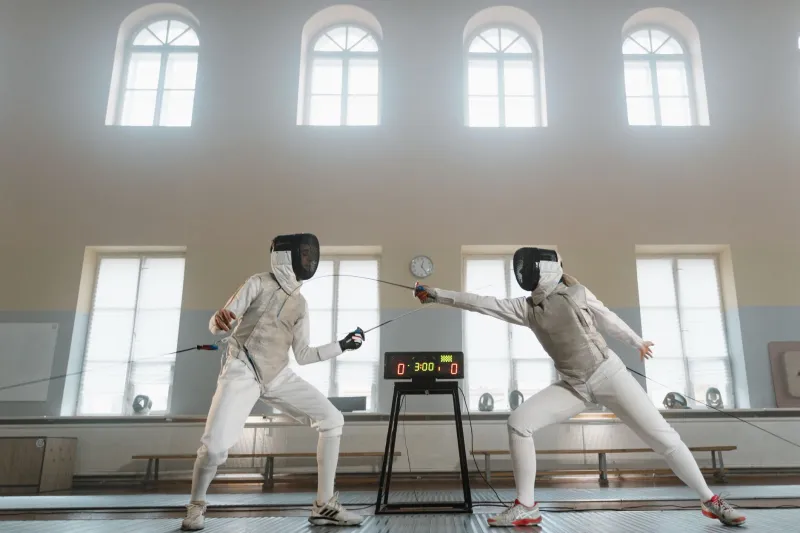
What is less frequently examined — particularly in the context of fencing — is the specific mechanism through which that advantage operates, and what a visiting competitor can do to systematically neutralize it. The 2018 European Fencing Championship in Novi Sad provided a concentrated case study in exactly this dynamic, with American competitors navigating an environment calibrated, in every meaningful sense, for European success.
This article is not interested in the myth that home advantage is simply about crowd noise or partisan officiating. The reality is considerably more nuanced, and the countermeasures available to American fencers are more sophisticated than simply telling an athlete to block out the crowd.
Disaggregating the Advantage
Before developing any counterstrategy, it is essential to understand what home advantage at a continental championship actually consists of. Broadly, it operates across three distinct dimensions: environmental familiarity, psychological comfort, and systemic support density.
Environmental familiarity encompasses everything from the physical characteristics of the competition venue to the practical logistics of daily life during a multi-day event. European competitors attending a championship in a neighboring country are navigating a cultural and logistical landscape that differs from their home environment in degree rather than in kind. Time zones are minimal or nonexistent. Dietary continuity is relatively straightforward to maintain. Language barriers, where they exist, are typically manageable. For American competitors traveling across the Atlantic, every one of these variables represents an additional cognitive and physiological load.
Psychological comfort is subtler but arguably more significant. European fencers competing at continental championships are performing in front of audiences that understand the sport, within institutional frameworks that have supported their careers, and against opponents whose names and reputations they have encountered repeatedly throughout their competitive development. The competitive environment, in other words, is familiar in a way that goes beyond venue logistics. It is familiar in the way that a professional athlete performing in their home league feels familiar — rooted, legible, and psychologically safe.
Systemic support density refers to the concentration of coaching, medical, logistical, and psychological support resources that European national programs can deploy at a continental championship with an efficiency that American programs, operating far from their home base, struggle to match.
The Physiological Reality of Transatlantic Competition
Before addressing the psychological dimensions of competing in Europe, American fencers and their coaches must contend with a more immediate challenge: the physiological disruption of transatlantic travel.
The time difference between the Eastern United States and Central Europe runs to approximately six hours, with the West Coast differential extending to nine. For a multi-day championship beginning with pool bouts and progressing through direct elimination rounds, the cumulative effect of circadian disruption on reaction time, decision-making speed, and physical recovery capacity is not trivial.
Research on athletic performance and jet lag consistently indicates that adaptation to eastward time zone transitions — which is what American athletes traveling to Europe experience — requires approximately one day of recovery for each hour of time difference. That means a West Coast fencer arriving in Central Europe requires up to nine days of acclimatization to perform at full physiological capacity. Most American championship delegations do not build that kind of arrival buffer into their competition schedules.
The practical recommendation is straightforward, if logistically demanding: arrive early. A minimum of five to seven days of pre-competition residency in the host country, with structured training sessions at or near the competition venue, represents the single most impactful physiological preparation step available to American competitors.
Building Environmental Familiarity Deliberately
For American fencers who cannot arrive weeks in advance, deliberate environmental familiarization during the available pre-competition window becomes critically important.
This means visiting the competition venue as early as access permits — not simply to observe the space, but to engage with it physically. Walk the perimeter. Stand on the competition pistes. Observe the lighting angles. Note the acoustic environment. The goal is to convert the unfamiliar into the merely novel, reducing the cognitive tax that an entirely alien environment imposes on competitive focus.
Similarly, maintaining as much routine continuity as possible during the competition period — consistent sleep scheduling, familiar nutritional practices, established pre-bout warm-up protocols — provides psychological anchoring that partially compensates for the environmental disruption of competing abroad.
Crowd Psychology and the Attention Management Framework
The crowd dimension of home advantage is real but frequently mismanaged by visiting athletes. The instinctive response to a hostile or partisan crowd is resistance — an attempt to actively suppress awareness of the crowd's presence. Research in sports psychology suggests this approach is generally counterproductive, as the act of suppression itself consumes attentional resources that would be better directed toward competitive performance.
A more effective framework, widely used in elite sport psychology, involves acknowledgment and redirection rather than suppression. The athlete acknowledges the presence of the crowd, briefly and without judgment, and then deliberately redirects attentional focus to a specific, concrete competitive cue — a technical element, a tactical intention, a physical sensation associated with optimal performance.
For fencing specifically, this redirection cue might be as simple as a deliberate breath cycle during the en garde command, a physical grounding routine during the halt between touches, or a consistent internal verbal cue tied to tactical intention. The specificity of the cue matters more than its content. What it provides is a reliable attentional anchor that the athlete can deploy consistently regardless of the external environment.
Pre-Competition Protocols That Travel Well
The most robust preparation for competing in an unfamiliar, potentially hostile environment is a pre-competition routine that has been practiced so extensively at home that it becomes self-executing under pressure.
American fencers preparing for European competition should develop and rehearse a full competition-day protocol — from morning wake-up through warm-up to the first bout — with sufficient repetition that it requires minimal conscious direction to implement. That automaticity is what allows the protocol to function as a psychological stabilizer when the environment is unfamiliar and the cognitive load of adaptation is highest.
The 2018 European Championship offered instructive examples of American competitors whose pre-bout preparation appeared inconsistent or improvised in contrast to European opponents whose routines were visibly practiced and systematic. That consistency gap is not a talent differential. It is a preparation differential, and it is entirely addressable.
Reframing the Disadvantage
Finally, it is worth noting that competing in an unfamiliar environment, while genuinely challenging, carries a psychological dimension that can be reframed as an asset rather than a liability. American fencers competing in Europe are, by definition, operating outside their comfort zone — and elite competitive performance, at its core, is fundamentally about the capacity to perform outside one's comfort zone.
Athletes who have developed the mental discipline to perform consistently in unfamiliar environments acquire a competitive resilience that their more comfortable domestic opponents may lack. The home advantage myth is not that home advantage is nonexistent. It is that visiting competitors are necessarily at a disadvantage. With deliberate preparation, the gap is closeable — and the process of closing it builds exactly the kind of psychological toughness that defines elite performers in any sport.