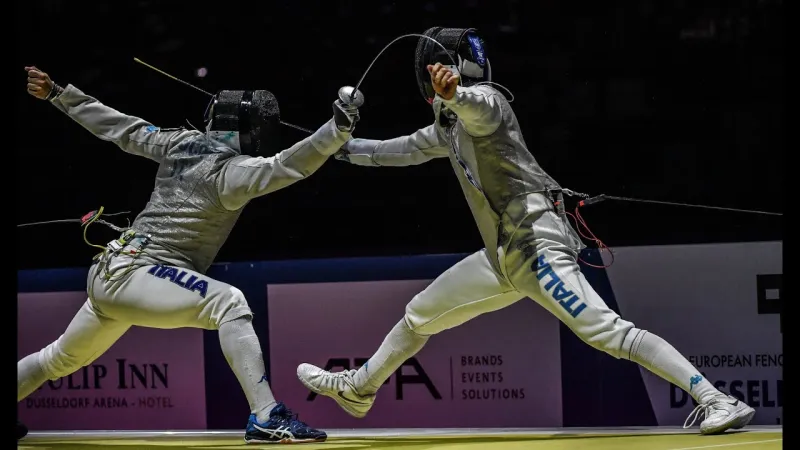
When the Favorites Fell: Unpacking the Upsets and Surprises of the 2018 European Fencing Championship
Every major championship generates a class of expectations. Rankings are consulted, recent form is assessed, head-to-head records are tabulated, and a consensus emerges about which athletes are most likely to stand on the podium. The 2018 European Fencing Championship in Novi Sad was no exception. Analysts and federations alike entered the competition with a reasonably confident set of predictions. By the time the final bouts concluded, a significant portion of those predictions had been dismantled.
This is not unusual in fencing, but the scale and pattern of the surprises at the 2018 championship merit closer examination. Understanding not just that predictions failed, but why they failed, offers a more honest picture of what the sport actually rewards — and what conventional forecasting consistently underweights.
The Forecasting Framework and Its Assumptions
Most pre-championship analysis of fencing relies on a combination of World Ranking points, recent Grand Prix and World Cup results, and historical performance at major championships. This framework is logical and, in most sports, reasonably reliable. A tennis player ranked first in the world wins major tournaments at a rate that broadly tracks expectations. A top-ranked sprinter converts their seed into a medal more often than not.
Fencing, however, operates under conditions that make this translation substantially less reliable. Bouts are decided by razor-thin margins — a single touch, a fraction of a second — and the direct-elimination format means that one bad five-minute period can end a championship campaign that took four years to build. The sport's scoring system, particularly the nuances of right-of-way in foil and sabre, introduces a layer of referee interpretation that has no direct equivalent in most other athletic disciplines. These structural features compress the gap between the best athlete in the world and the fifteenth-best in ways that rankings do not fully capture.
Where the Predictions Went Wrong in 2018
Several patterns emerged from the 2018 results that diverged sharply from pre-tournament expectations.
First, athletes who had dominated the Grand Prix circuit in the months before the championship frequently encountered difficulty translating that form to the championship environment. Grand Prix events, while prestigious, operate under subtly different psychological conditions than a continental championship. The stakes are higher in Novi Sad, the preparation more concentrated, and the opponent pool more specifically motivated. Athletes who thrive on the consistency of a long competitive season sometimes struggle when the format compresses everything into a single elimination bracket.
Second, younger athletes — those competing in their first or second senior European Championship — outperformed their rankings at a rate that surprised many observers. This is a pattern worth noting. Junior-to-senior transition is one of the most analytically underweighted variables in fencing forecasting. An athlete who has spent years dominating junior circuits arrives at senior championships without the accumulated psychological weight of previous near-misses. They fence without the specific fear of repeating a prior failure, which in a sport decided by fractions of a point, is a meaningful competitive advantage.
Third, several athletes who had been identified as podium contenders based on their head-to-head records against top competitors were undone by opponents they had rarely, if ever, faced. Fencing is acutely sensitive to stylistic matchups. A technically orthodox fencer who handles conventional attacks with ease may be genuinely vulnerable to an opponent whose timing, distance management, or blade work falls outside the patterns they have trained to recognize and counter. World Rankings aggregate results across opponents but do not weight stylistic compatibility — a gap that the 2018 bracket exposed on multiple occasions.
The Variables That Forecasters Consistently Miss
Beyond the structural features of the sport, the 2018 championship highlighted several athlete-specific variables that resist quantification but demonstrably influence outcomes.
Physical peaking is one. Fencing is a sport in which the difference between an athlete at 95 percent of their physical capacity and one at 100 percent is often invisible to observers but felt acutely by the fencer. An athlete who has traveled extensively in the weeks before the championship, or who carried a minor injury through the final months of the season, may appear on paper to be in competitive form while actually operating below their own threshold. Pre-tournament reports rarely capture this with precision.
Coaching dynamics are another. A change in coaching staff, even a temporary one, can disrupt the specific tactical planning that an athlete depends on during direct elimination. The 2018 championship featured several instances where athletes whose preparation had been interrupted by coaching transitions fared noticeably worse than their rankings suggested they should.
Finally, the pressure of home-adjacent competition affected certain athletes in ways that were difficult to predict. Competing in Novi Sad meant that several Balkan and Central European athletes faced a level of crowd expectation that is simply absent at more neutral venues. For some, that energy was fuel. For others, it was an additional weight that their mental preparation had not fully accounted for.
What This Means for How We Watch the Sport
For American audiences approaching elite fencing as either spectators or competitors, the 2018 European Championship offers a useful corrective to over-reliance on rankings as a predictive tool. The sport rewards preparation, adaptability, and psychological composure in ways that aggregate statistics capture imperfectly. A fencer ranked twelfth who peaks at the right moment, draws a stylistically favorable bracket, and executes their game plan under pressure is entirely capable of defeating the world's top-ranked athlete on a given day.
That unpredictability is not a flaw in fencing's competitive structure. It is, in many respects, one of the sport's most compelling characteristics. The 2018 championship reminded everyone watching — analysts, coaches, and competitors alike — that a ranking is a summary of the past, not a guarantee of the future. In Novi Sad, the fencers who understood that distinction most clearly were often the ones still standing at the end.