Every Step Counts: How European Footwork Mastery Is Redefining What It Means to Control the Piste
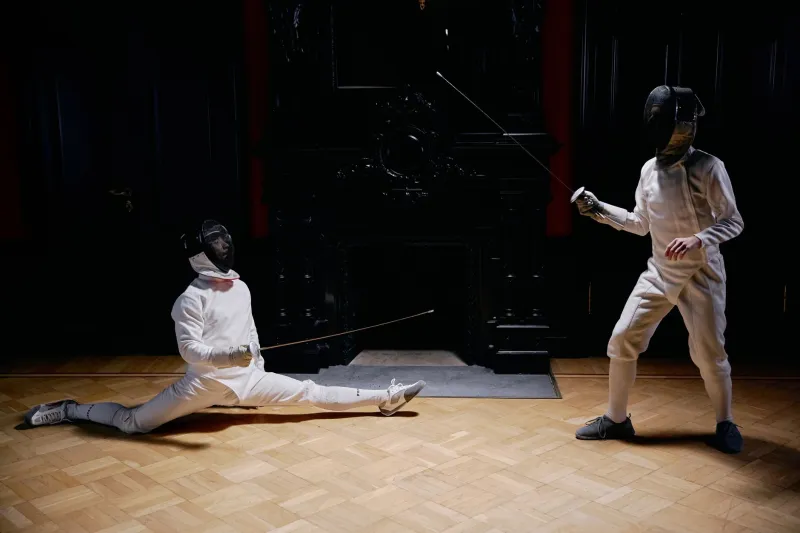
Watch a bout at the 2018 European Fencing Championship for long enough, and a pattern begins to emerge that has little to do with blade work. The athletes who advance deepest into the competition bracket are, almost without exception, those who move with a quality of purposefulness that distinguishes them from their opponents before a single touch is scored. Their feet tell a story of spatial intelligence — of a relationship with distance that is as cultivated and deliberate as any technical skill in their arsenal.
For American fencers accustomed to evaluating performance primarily through offensive output, this emphasis on movement economy represents a genuinely different way of thinking about the sport.
The European Philosophy of Distance
In the training environments that have produced the 2018 Championship's top competitors, distance management is not treated as a supplementary skill — it is foundational. European coaching methodology, particularly in the French, Hungarian, and Russian traditions, frames the piste as a dynamic spatial problem that must be solved continuously throughout a bout. Every advance, retreat, and lateral adjustment is understood as a statement of intent, one that either expands or contracts the range of tactical options available to both fencers.
This philosophy manifests in a specific quality of footwork that experienced observers can identify almost immediately: European elite fencers tend to move in ways that preserve their options rather than committing prematurely. Their steps are measured, their weight distribution carefully managed, and their transitions between offensive and defensive postures notably fluid. The effect is that opponents frequently find themselves reacting to footwork as much as to blade actions — a disorienting experience for athletes trained primarily to read steel.
American fencing, shaped by a training culture that has historically prioritized explosive attack and high-tempo exchanges, sometimes produces competitors who are tactically brilliant in close-quarters combat but less sophisticated in the deliberate, patient management of distance that European opponents exploit so effectively.
Reading the Bouts: Specific Patterns from Novi Sad
The 2018 Championship in Novi Sad has provided numerous examples of European distance management operating at its highest level. In épée competition, where the entire body serves as a valid target and defensive considerations are correspondingly complex, the footwork differential between European and non-European competitors has been particularly pronounced.
Several of the championship's leading épéeists have demonstrated a technique that might be described as "controlled retreat" — a pattern in which apparent defensive withdrawal is actually a mechanism for resetting distance to a range where the retreating fencer holds a specific advantage. Rather than simply backing away under pressure, these athletes use retreat to draw opponents into overextension, then exploit the resulting vulnerability with precisely calibrated counter-attacks. The footwork required to execute this pattern reliably demands not only physical conditioning but a sophisticated real-time sense of exactly where on the piste each fencer stands and how much space remains available.
In sabre competition, the footwork dynamics are different but equally instructive. The explosive advances and fleches that characterize sabre at the highest level require athletes to manage acceleration and deceleration with remarkable precision. European sabre competitors at the 2018 Championship frequently demonstrate the ability to initiate an advance, read their opponent's response mid-movement, and adjust their trajectory or timing without the kind of telegraphing that would allow a prepared defender to capitalize. This mid-action adaptability is a product of footwork training that emphasizes proprioceptive awareness — knowing where your body is in space without having to consciously direct your attention there.
The Training Methodologies Behind the Movement
The footwork sophistication visible at the 2018 Championship does not emerge from conventional drill repetition alone. European training programs, particularly at the national development level, incorporate a range of methodologies designed to build spatial awareness as a genuine cognitive skill rather than a purely physical one.
Shadow fencing — extended practice sessions in which athletes move through attack, defense, and distance management sequences without an opponent — is used more systematically in European programs than in most American clubs. The purpose is to internalize movement patterns so thoroughly that they become available under competitive pressure without conscious deliberation. When an athlete must think about where to place their feet, they are simultaneously not thinking about their opponent's blade, their own tactical options, or the score — cognitive resources that should be available for higher-order decisions.
Video analysis of footwork patterns, now standard practice among European national programs, allows coaches and athletes to identify habits and tendencies that are invisible in the moment of competition. American programs that have begun incorporating similar analysis tools report that athletes frequently discover significant gaps between their perceived footwork and what the footage actually reveals — a humbling but productive experience.
Conditioning work specifically targeting the hip flexors, ankle stability, and lateral movement capacity also features more prominently in European training regimens than in typical American club programming. The physical demands of European-style distance management require a specific kind of lower-body conditioning that general athletic fitness does not automatically provide.
Actionable Insights for American Clubs and Athletes
The gap between European and American footwork sophistication is real, but it is not insurmountable. Several specific adjustments are within reach for American clubs and individual competitors willing to reframe how movement is taught and practiced.
First, incorporating dedicated distance-management drills — exercises in which athletes practice maintaining, closing, and opening distance with a training partner without any blade contact — builds the spatial sensitivity that underpins European-style footwork. These drills are deceptively simple in structure but reveal significant differences in movement quality almost immediately.
Second, introducing video review of footwork specifically, separate from blade-action analysis, helps athletes and coaches identify the habitual patterns that opponents at international competitions will inevitably discover and exploit.
Third, exposing American athletes to extended bouts against European-trained competitors — whether through international travel, invitational tournaments, or training exchanges — accelerates footwork development more effectively than any drill-based approach. There is no substitute for the experience of having one's distance management tested by an opponent who has been solving exactly these problems since early adolescence.
The 2018 European Fencing Championship is, among many other things, a clinic in what deliberate, systematic footwork development produces at the highest competitive level. American athletes and programs that study these patterns carefully will find that the piste is a considerably more spacious tactical environment than they may have previously appreciated — and that controlling that space is a skill very much worth acquiring.