Blueprint for Excellence: What American Fencing Facilities Can Learn from the 2018 European Championship Venues
When American fencing coaches and club directors traveled to the 2018 European Fencing Championship, many arrived expecting to observe athletes. What they encountered, however, was something equally instructive: a physical environment engineered to produce champions. The venues hosting this year's competition were not simply arenas — they were carefully designed ecosystems in which every surface, every lighting rig, and every square foot of warm-up space had been calibrated to support peak performance. For the American fencing community, the experience has prompted an urgent and overdue conversation about the state of domestic facilities.
The European Standard: More Than Just a Strip of Floor
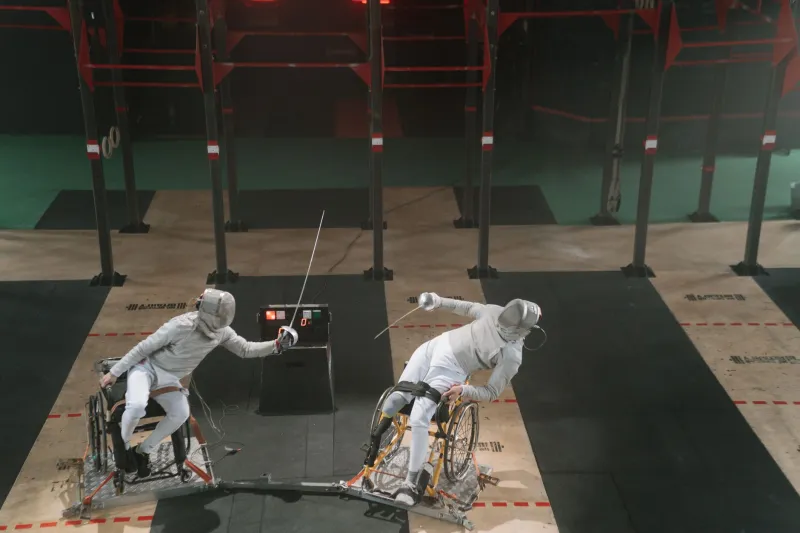
At first glance, a fencing piste is a fencing piste. Fourteen meters of regulated competition surface, bounded by clear markings and flanked by scoring equipment. Yet the venues at the 2018 European Championship demonstrated that the details surrounding that strip matter enormously. The flooring systems in use across the primary competition halls were purpose-built for fencing — offering the precise combination of grip and slide that the sport demands, while reducing the cumulative joint stress that plagues fencers competing across multi-day tournaments.
Beyond the surface itself, the spatial organization of competition halls reflected a sophisticated understanding of athlete flow. Warm-up areas were positioned to allow fencers to transition seamlessly from preparation to competition without navigating crowded corridors or losing body temperature. Designated cool-down zones, equipped with foam rollers, resistance bands, and medical staff, were integrated directly into the venue layout rather than relegated to distant back rooms. These are not luxuries — they are structural decisions that directly affect how athletes perform when it counts.
For American facility directors observing these arrangements, the contrast with many domestic venues was difficult to ignore. A significant number of U.S. fencing clubs and university programs operate in repurposed gymnasiums, multi-use recreation centers, or aging athletic facilities that were never designed with the sport's specific requirements in mind. The European Championship venues made clear just how much that compromise costs in competitive terms.
Lighting, Technology, and the Sensory Environment
One of the more technically sophisticated aspects of the 2018 championship venues was their approach to lighting. European competition organizers have increasingly recognized that fencing is a sport of split-second visual discrimination — the ability to read an opponent's blade angle, shoulder rotation, and foot placement in fractions of a second. The lighting systems deployed at this year's venues were designed to eliminate shadow zones on the piste, minimize glare on metallic equipment, and maintain consistent illumination across all strips regardless of their position within the hall.
This level of investment in the sensory environment stands in contrast to many American facilities, where overhead fluorescent lighting — often uneven and poorly positioned — remains the standard. Several American coaches who attended the championship noted that their athletes frequently train under conditions that do not prepare them for the visual clarity of a properly lit European competition hall, creating an adjustment challenge that compounds the other pressures of international competition.
The integration of electronic scoring infrastructure also merited attention. Rather than portable, frequently recalibrated systems wheeled in for events, the championship venues featured built-in scoring technology with standardized cabling, consistent sensitivity settings, and rapid technical support. American clubs looking to modernize their facilities would do well to consider fixed infrastructure as a long-term investment rather than continuing to rely on equipment that varies in performance from session to session.
What American Clubs and Universities Are Saying
The response from American facility directors who have reviewed footage and reports from the 2018 championship has been a mixture of admiration and pragmatic concern. The central challenge, as several directors have noted in conversations with this publication, is not a lack of will but a structural funding gap.
European fencing facilities — particularly those affiliated with national federations or Olympic development programs — benefit from centralized funding models and long-term infrastructure commitments that most American clubs simply do not have access to. University programs face their own constraints, competing for capital improvement budgets against higher-profile revenue sports. Independent clubs, meanwhile, operate on membership dues and grant funding that rarely extends to large-scale facility renovation.
Yet the picture is not entirely discouraging. Several facility directors have identified targeted, cost-effective interventions that could meaningfully close the gap without requiring wholesale reconstruction. Replacing flooring in dedicated fencing rooms with sport-specific surfaces — an investment that runs in the range of several thousand dollars per strip for quality materials — is frequently cited as the single highest-impact improvement available to American clubs. Upgrading lighting systems to LED arrays with adjustable color temperature and intensity represents another achievable step, one that also reduces long-term energy costs.
For university programs with greater capital access, the 2018 championship venues have provided a concrete reference point for facility planning discussions. The argument for dedicated fencing space — rather than shared multi-sport areas — becomes considerably more persuasive when administrators can point to documented evidence of how facility design influences competitive outcomes at the highest level of the sport.
The Relationship Between Space and Performance
Underlying all of these specific observations is a broader principle that the 2018 European Championship has brought into sharp focus: the physical environment of training and competition is not a neutral backdrop. It actively shapes the habits, expectations, and physical capabilities of the athletes who inhabit it.
Fencers who train on substandard surfaces develop compensatory movement patterns. Athletes who warm up in cramped, poorly organized spaces carry residual tension into competition. Clubs that cannot offer consistent, high-quality infrastructure struggle to retain advanced fencers and attract the coaching talent necessary to develop them. The facility question, in other words, is inseparable from the broader question of American fencing's competitive trajectory.
The 2018 European Championship has served as an unusually clear mirror in this regard. The venues did not simply host great fencing — they helped produce it. And for American clubs and programs willing to engage seriously with that lesson, the path forward, while not without obstacles, is considerably clearer than it was before the competition began.
Looking Ahead
The conversations sparked by this year's championship are already translating into action in some corners of the American fencing community. Facility planning committees at several university programs have reportedly begun incorporating European venue specifications into their renovation briefs. Independent clubs in major metropolitan areas are exploring shared-space models that would allow multiple organizations to collectively fund facility upgrades that none could afford individually.
These are early steps, and the distance between American facilities and the European standard remains substantial. But the 2018 European Fencing Championship has provided something valuable: a detailed, visible, and compelling argument for why that distance must be closed — and a clear picture of what closing it would look like.